Università di Pisa, May 20-21, 2026
Palazzo Boileau, via Santa Maria 85, Pisa
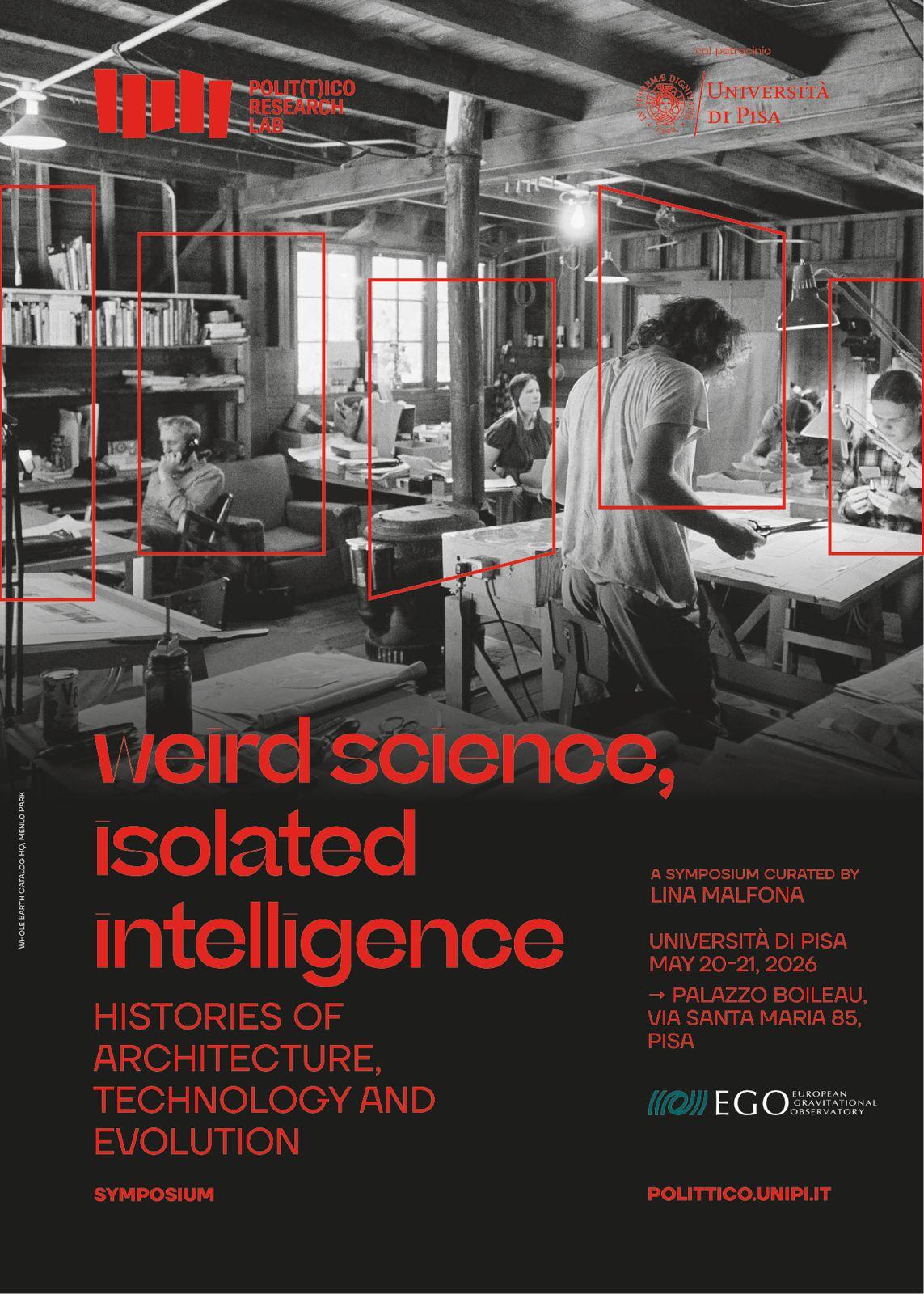
The title makes us think of the oddities usually conceived by the mind of a brilliant or eccentric individual, like that of Emmett Brown, the mad scientist who invents time travel in Robert Zemeckis’ film Back to the Future (1985)—who, not coincidentally, lives in the Gamble House, the masterpiece of the Greene brothers. Architecture itself may be seen as a singular practice, positioned between art and science. The figures of the solitary inventor, the pioneer, the architect-demiurge are at the heart of this investigation, as are the places where scientists live, their house-studios, their research labs, their inventions, tools, techniques, and their very lives, their hideaways, their host countries, their journeys, their relocations.
Although employing different tools, architects and scientists both base their work on creativity. Through their work, they seek to physically realize an idea that exists in their own minds, or to extract what is already present but hidden in the object of their study. Before being shared, discussed, and disseminated, an invention requires careful study, concentration, and isolation. Like invention, a masterpiece is not the product of teamwork, but rather an individual phenomenon, arising from the combination of creative intelligence and technical knowledge. Yet it is commonly held that invention is potentially a harbinger of progress that influences all of humanity, whereas the masterpiece remains confined to the narrow yet exclusive and autonomous realm of art.
This call for abstracts asks, on the one hand, whether there exist architectural masterpieces that, in addition to changing space or the way it is conceived, inhabited, and experienced, have also contributed to the progress of human history. On the other hand, the call aims to intercept those inventions that emerge as the result of individual intelligence, conceived by solitary, isolated, excluded, exiled, nomadic, marginalized scientists, forced to emigrate due to tensions, conflicts or wars.
The call is structured into three sessions, entitled SPACE, NATURE, and MACHINE.
CONFERENCE PROGRAM
DAY 1 | 20 May 2026
09:45 Opening remarks
Renato Iannelli (University of Pisa)
09:50 Weird Science, Isolated Intelligence. Introduction to the day of study
Lina Malfona (University of Pisa)
10:00 Keynote lecture
Big Telescopes and Big Art: Expanding Knowledge and Looking for Meaning Between the Heavens and the Earth
Stuart W. Leslie (Johns Hopkins University)
SESSION 1 – SPACE
Chaired by Jacopo Leveratto (Politecnico di Milano) and Cecilia Marcheschi (University of Pisa)
10:30Cathedrals of Modern Industry: Gaetano Minnucci’s Hydroelectric Power Stations
Diana Carta (Sapienza University of Rome)
11:00Making the Invisible Visible: the Architecture of the MACRO and ICARUS Experiments at Gran Sasso National Laboratory, Italy
Filippo De Dominicis (University of L’Aquila)
11:30Red Space. Cosmism in the Soviet Architectural Avantgarde
Luca Lanini (University of Pisa)
12:00Patenting Architecture. Frances Gabe’s Self-Cleaning House
Laura Mucciolo (Sapienza University of Rome)
12:30 Discussion
13:00 Lunch Break
SESSION 2 – NATURE
Chaired by Andrea Crudeli, Lucia Giorgetti and Francesca Molle (University of Pisa)
14:30Alexander Pike and the Population Bomb Shelter
Max Bouttell (Maastricht University)
15:00 Alien Earth: Architectures of Nonhuman Intelligence
Clemens Finkelstein (Ludwig Maximilian University of Munich)
15:30Visionary New York. A Proactive Manifesto for Manhattan
Josep Maria Garcia-Fuentes (Politecnico di Milano)
16:00Dynamic Construction: Ecosystem Concepts in Architecture after the 1960s
Anna Renken (University of Toronto)
16:30Experiments Out of Thin Air: Angelo Mosso’s Altitudinal Laboratory
An Tairan (ETH Zürich)
17:00 Discussion
DAY 2 | 21 May 2026
09:55 Opening remarks
Vincenzo Napolano (EGO European Gravitational Observatory)
SESSION 3 – MACHINE
Chaired by Per-Johan Dahl (Lund University), Elisa Barsanti and Benedetta Marradi (University of Pisa)
10:00Weird and Eerie Inventors: Reading Three Machines by Cedric Price
Antonio Azzolini (independent researcher)
10:30From VisiCalc to Datatown: Architecture’s Tabular Interfaces in the Long Digital Turn
Matīss Groskaufmanis (TU Delft)
11:00Between Human and Machine: The Lesson from “Civiltà delle macchine”. Reflection on the Contemporary Relevance of Leonardo Sinisgalli’s Thought
Monica Manicone (independent researcher)
11:30Coded Architectures: A Global Experiment
Marya Rusak (Karlsruhe Institute of Technology)
12:00Blind Machines of Divination: On the mimesis of the unrepresentable at the Los Alamos Scientific Laboratory
Uri Wegman (Université Libre de Bruxelles)
12:30 Discussion
13:00 Conclusions
Organizing Committee
Lina Malfona, Università di Pisa (lina.malfona@unipi.it)
Elisa Barsanti, UniPi (elisa.barsanti@phd.unipi.it)
Lucia Giorgetti, UniPi (lucia.giorgetti@ing.unipi.it)
Cecilia Marcheschi, UniPi (cecilia.marcheschi@phd.unipi.it)
Benedetta Marradi, UniPi (b.marradi@hotmail.it)
Francesca Molle, UniPi (francesca.molle@phd.unipi.it)
Advisory Board
Alessandro Armando, Politecnico di Torino
Fabio Capanni, Università di Firenze
Per-Johan Dahl, Lund University
Lydia Kallipoliti, Columbia University
Vittorio Marchis, Politecnico di Torino
Alessandro Tredicucci, Università di Pisa
In collaboration with EGO European Gravitational Observatory